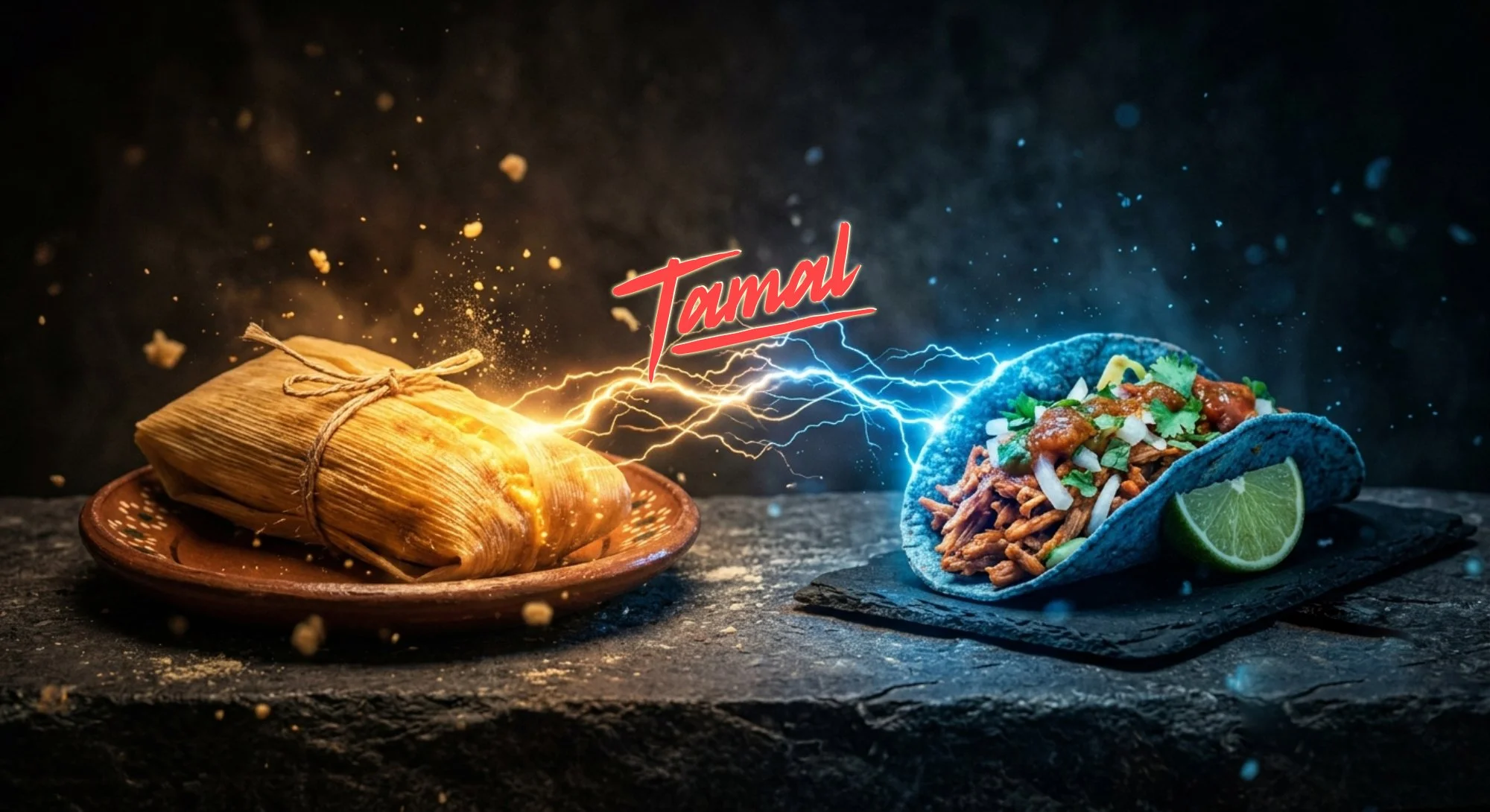
Here at Tamal, we don't do things halfway. So when we set out to build a new signature item, we didn't just mash two foods together and call it a day. We went digging. Way, way back. Turns out the two things we were about to combine, the tamal and the taco, have histories so old and so wild that putting them together almost feels like fate. Or at least a really good idea we're glad nobody beat us to. Yes this is a Tamal Original.
Let us tell you a story.
First, the elder statesman: The Tamal
The tamal is old. We're talking civilization old. Archaeologists trace the tamal back to somewhere between 8000 and 5000 BC in Mesoamerica, which makes it one of the oldest continuously eaten foods in the Americas. It predates the Aztecs. It predates the Maya. It was already ancient by the time the pyramids of Mexico were a thought in anyone’s mind.
Here's the part we love. Nobody invented the tamal. It wasn't dreamed up by a celebrity chef or a clever emperor. It was invented by necessity, by early people who needed food that was nutritious, portable, and wouldn't spoil on a long hunt or a longer migration. The genius was the wrapper: a corn husk or banana leaf that cooked the masa, kept it clean, and traveled well. In other words, the tamal was the world's original to-go meal. An ancient grab-and-go, thousands of years before anyone thought to put a window on the side of a truck.
The word itself comes straight from the Aztecs. In Nahuatl, their language, it was tamalli, meaning roughly "wrapped" or "steamed corn dough." These weren't just snacks, either. Tamales were sacred, offered to the gods, packed as rations for warriors, and shared at community feasts. Some cultures even used them as a form of tribute to their rulers. Imagine paying your taxes in tamales. Honestly, we'd take that deal.
So that's the tamal: ancient, sacred, portable, and beloved for roughly nine millennia. Respect your elders.
Now, the young upstart: The Taco
Plot twist. For all the tamal's ancient pedigree, the taco is practically a newborn.
We know that sounds wrong. The taco feels timeless. But the food historians will tell you the taco as a named thing is barely more than a century old, and its origin story is far stranger than you'd expect. According to Jeffrey Pilcher, a historian who has spent decades chasing tacos around the globe, the word most likely comes from the silver mines of 18th-century Mexico.
In those mines, a "taco" wasn't food at all. It was a little charge of gunpowder, wrapped in paper and shoved into a hole in the rock to blast it apart. And when a miner rolled up a tortilla around some filling, it looked, to a miner's eye, exactly like one of those little paper-wrapped explosives. As Pilcher himself put it, a good chicken taquito with hot sauce really is a lot like a stick of dynamite. The first tacos on record even had a name that fits the story: tacos de minero, miner's tacos.
There's a second, quieter theory too, that "taco" comes from the Nahuatl tlahco, meaning "half" or "in the middle," which is a pretty fair description of what you do to a tortilla before you eat it. Either way, the taco was born working-class: cheap, filling, fast, and made for people who needed to eat with one hand and get back to work. From the mines it spread to the streets, the taquerías, the food carts, and eventually the whole planet.
So there you have it. The tamal, the 9,000-year-old sacred survival food. The taco, the young, scrappy, working-class hand-held that got its name from dynamite.
And this is where Tamal comes in
We kept staring at these two. Both born from the same magic ingredient, corn. Both built to be eaten on the move. Both belonging, deep down, to working folks who needed something bold, filling, and portable. They're practically family. They've just never been formally introduced.
So we introduced them.
Meet The Tacomal. We take our signature big blue masa tamal, the hearty, handmade, nearly-double-sized kind we're known for, and we tuck it into a warm, char-kissed blue corn tortilla. The ancient survival food, riding inside the working-class hand-held. Nine thousand years of tamal meets a hundred-and-some years of taco, folded into one thing you can eat standing up in our courtyard on a Saturday afternoon.
We checked, by the way. As far as we can tell, nobody's officially claimed the Tacomal. Which feels about right. Somebody had to be the one to finally put these two together, and we're honored it's us. It's a Tamal Original, through and through.
Is it traditional? Not exactly. But here's the thing about both the taco and the tamal: they were never frozen in time. The tamal picked up pork and cheese from the Spanish. The taco picked up al pastor from Lebanese immigrants and a crunchy shell from Mexican-Americans up north. These foods have always evolved, always absorbed, always reinvented themselves in the hands of the people making them. That's not us breaking tradition. That's us honoring it.
So come find us on the square. Order a Tacomal. Take a bite of something that took nine thousand years to arrive, and about four dollars to order.
We think your ancestors would approve.
The Tacomal is available now at Tamal, on the square. $4, includes one tamal regular topping of your choice. Choose your Tamal: Salsa Roja Pork, Salsa Verde Chicken, or Oaxaca Cheese & Roasted Jalapeño.
—-
Sources
Smithsonian Magazine, "Where Did the Taco Come From?" — interview with historian Jeffrey M. Pilcher on the silver-mine origins of the taco and the word taco. https://www.smithsonianmag.com/arts-culture/where-did-the-taco-come-from-81228162/
Taco, Wikipedia — etymology of "taco," including the silver-miner "plug" theory and the Nahuatl tlahco ("half / in the middle") theory. https://en.wikipedia.org/wiki/Taco
The Corner Taqueria, "The History of Tacos" — tacos de minero and the working-class spread of the taco. https://www.thecornertaqueria.com/history-of-tacos
Familia Kitchen, "A Guide to Tamales: Unwrapping Their History & Ingredients" — corn domestication ~9,000 years ago and the tamal's sacred role in Mesoamerican cultures. https://familiakitchen.com/a-guide-to-tamales-unwrapping-their-history-ingredients/
"The True Origin of Tamales: A Mesoamerican Story" — 8000–5000 BC timeline, the tamal as the original "to-go" meal, and the Nahuatl root tamalli. https://eathealthy365.com/the-true-origin-of-tamales-a-mesoamerican-story/
Rimping, "Ancient Mesoamerican Food History — Tamales" — 8,000-year history, Nahuatl origins, and Spanish-era additions of pork, beef, and cheese. https://www.rimping.com/blog/7757/history-tamales-mesoamerica
The Ultimate Guide to Tamale History (Number Analytics) — tamales used as tribute to rulers in Aztec and Mayan societies. https://www.numberanalytics.com/blog/ultimate-guide-tamale-history
A note on the history: food origins are famously slippery, and historians still debate exact dates and etymologies. We've done our best to stick to what the record supports. Any errors are ours, not our ancestors'.